- Roland’s Riff
- Posts
- Loyalty is expensive. Here's the bill.
Loyalty is expensive. Here's the bill.
The hidden tax no one invoices you for
TL;DR: The relationships you've never re-evaluated (early employees, legacy vendors, longtime partners) are quietly costing you in dollars, speed, and capability. Founders confuse loyalty with leadership, but a buyer will see every one of those unchallenged relationships as margin leakage and concentration risk. The fix isn't ruthlessness, it's asking "would I hire this person or sign this deal today at this price?" and being honest about the answer.
The Loyalty Tax: Your oldest relationships might be your most expensive ones.
Every founder has them. The vendor who's been with you since year one. The employee who was there "before it was a real company." The partner you'd feel guilty renegotiating with because they took a chance on you early.
These relationships feel like assets. They're often liabilities.
Not because the people are bad. But because loyalty, left unexamined, becomes a subsidy. And subsidies have a cost, even when nobody sends you the invoice.
What Loyalty Actually Costs
Here's the pattern I see constantly. A founder builds a business to $3M, $5M, $10M in EBITDA. The company has matured. The market has shifted. The demands on every role and every vendor relationship have evolved significantly.
But the people and partners in key positions haven't been re-evaluated against what the business needs now. They're evaluated against what they meant to the business then.
That early operations person who "figured it out" when there were no systems? They're still running ops, even though the role now requires someone with a completely different capability set. That vendor who gave you a break on pricing in year two? You're still paying them without ever testing the market, because switching feels disloyal.
This is the Loyalty Tax. It's the premium you pay, in dollars, in speed, in capability, to avoid an uncomfortable conversation.
Why Founders Can't See It
The Loyalty Tax is invisible to the person paying it because it's wrapped in identity. Founders pride themselves on loyalty. "I take care of my people" is one of the most common things I hear from operators who've built real businesses. And it's admirable.
But there's a difference between taking care of people and subsidizing underperformance. One is leadership. The other is avoidance wearing a leadership costume.
The longer a relationship has existed, the harder it becomes to evaluate objectively. Tenure creates a kind of emotional seniority that has nothing to do with contribution. And the founder, who sees the full history, can't separate gratitude from assessment.
A buyer can. And they will.
What Buyers See That You Don't
When a sophisticated buyer looks at your business, they don't see loyalty. They see cost structure, capability gaps, and concentration risk.
That long-tenured ops person who "knows where everything is"? A buyer sees a single point of failure with no documentation and no succession plan.
That vendor you've never renegotiated? A buyer sees margin leakage and a founder who doesn't manage procurement. That partner who gets favorable terms because of history? A buyer sees a contract that needs to be restructured on day one.
Every dollar of Loyalty Tax reduces your effective EBITDA in a buyer's model. And every role filled by tenure instead of capability becomes a line item in their post-acquisition integration plan. Those line items come directly off your purchase price.
The Real Question
This isn't about being cold. It's about being honest.
The question isn't "should I fire everyone who's been here since the beginning." The question is: "If I were hiring for this role today, with what I know now, would I hire this person again at this price?"
If the answer is yes, great. You don't have a loyalty problem, you have a retention asset.
If the answer is no, you have a tax. And you've probably been paying it for years.
The Conclusion
The businesses that command the highest multiples aren't the ones with the most loyal teams. They're the ones where every role, every vendor, every partnership is calibrated to current value, not historical sentiment.
Loyalty is a wonderful quality in a person. It's a terrible capital allocation strategy. The founder who builds a business worth owning is the one who learns to separate the two, not by becoming ruthless, but by becoming honest about what each relationship actually costs and what it actually delivers.
That's not disloyalty. That's clarity. And clarity is what makes you optional.
— Roland
Want more than just the weekly deep dives? On Instagram we share quick tips, behind-the-scenes looks, and first access to what’s coming next.
📲 Follow @RolandFrasier on Instagram and join the community.
Whats Going On Recently
Keep More Of Your Money: PRIME can show you how to protect yourself, grow assets, build business funding, and how to take advantage of 250+ unique tax deductions. Schedule Your Strategy Session Here


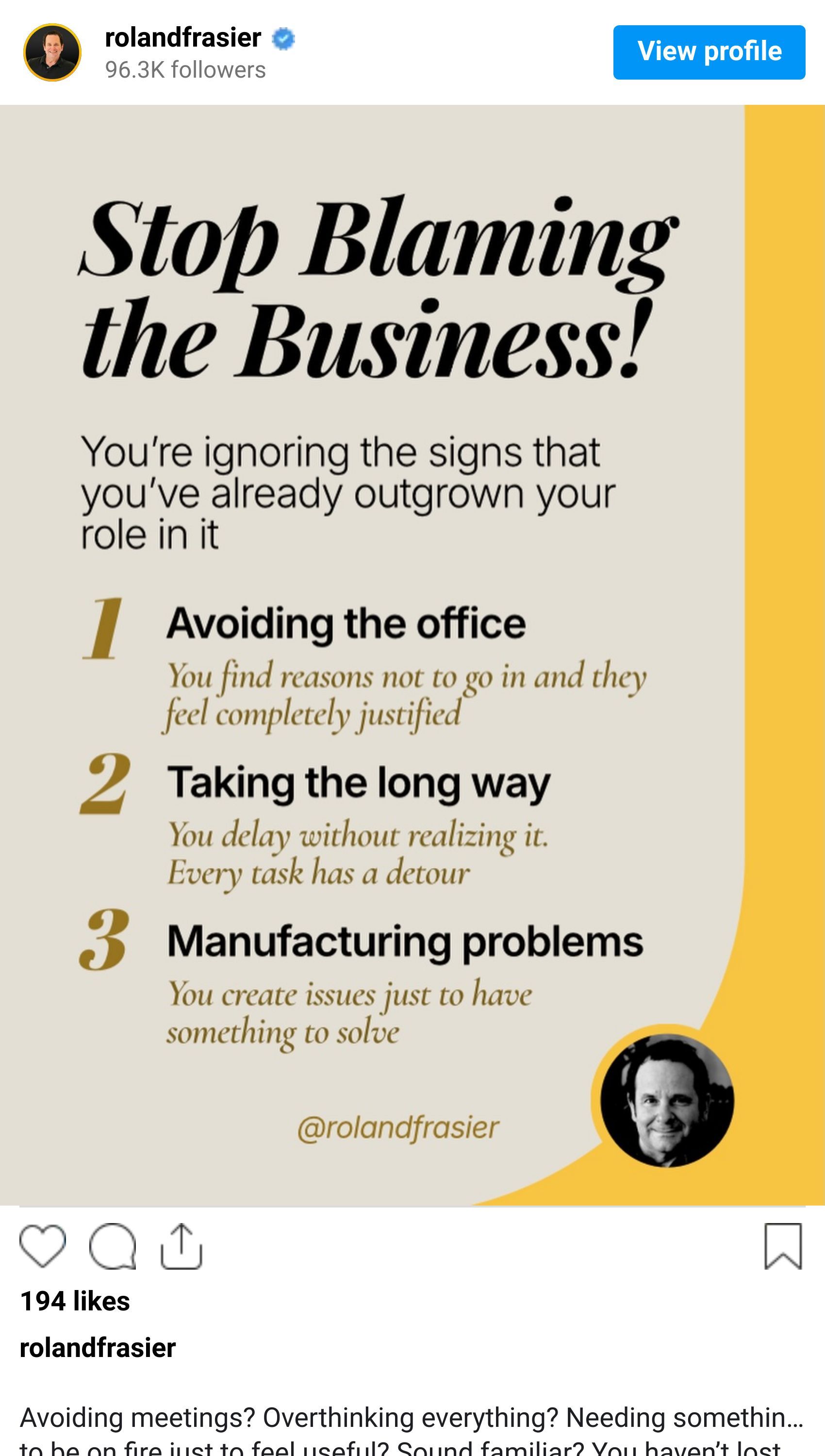
You haven’t lost your edge…It just feels like you have.
You start avoiding things you used to lean into. You overthink decisions that used to feel obvious. You need something urgent just to feel engaged again.
Most people think this means they’re burned out… or slipping. It’s usually something else entirely.
Have you outgrown your role in your business?

Thinking About Exiting Your Business?
You’ve built something incredible, now it’s time to make sure you get the most from your exit. We’ve helped countless entrepreneurs maximize their business sales, ensuring they walk away with more than just a deal, they walk away with the best deal possible.
Want to see what’s possible for you? Schedule a complimentary call (click here) today to see how I can help you get the most out of your exit.